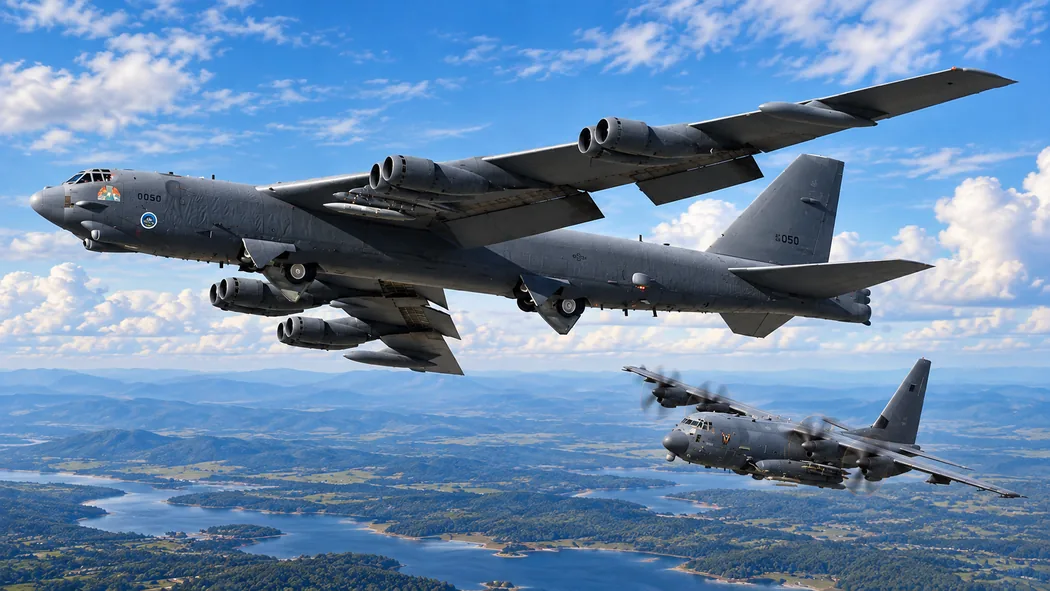
An AC-130 and a B-52 are both formidable aircraft. Both can deliver extraordinary firepower, but they were designed for different missions. Comparing them solely by payload, speed, or endurance would miss the point. The important question is not which aircraft is better. It is which aircraft is better suited to the mission.
I have two local AI computers named after those aircraft. AC130 is a compact AMD Ryzen AI Max+ 395 system with 128 GB of unified memory. B52 is a larger workstation equipped with a Threadripper PRO processor and four NVIDIA RTX 4090 GPUs.
They represent two approaches to running AI locally: one emphasizes accessible memory capacity in a compact package; the other emphasizes discrete GPU throughput and parallel execution. I ran identical model files on both systems, measured prompt processing and generation, tested concurrency, and collected reported GPU power.
The question is not which machine wins. It is which machine is suited to the mission.
Two Very Different Architectures
AC130
128 GB Unified Memory
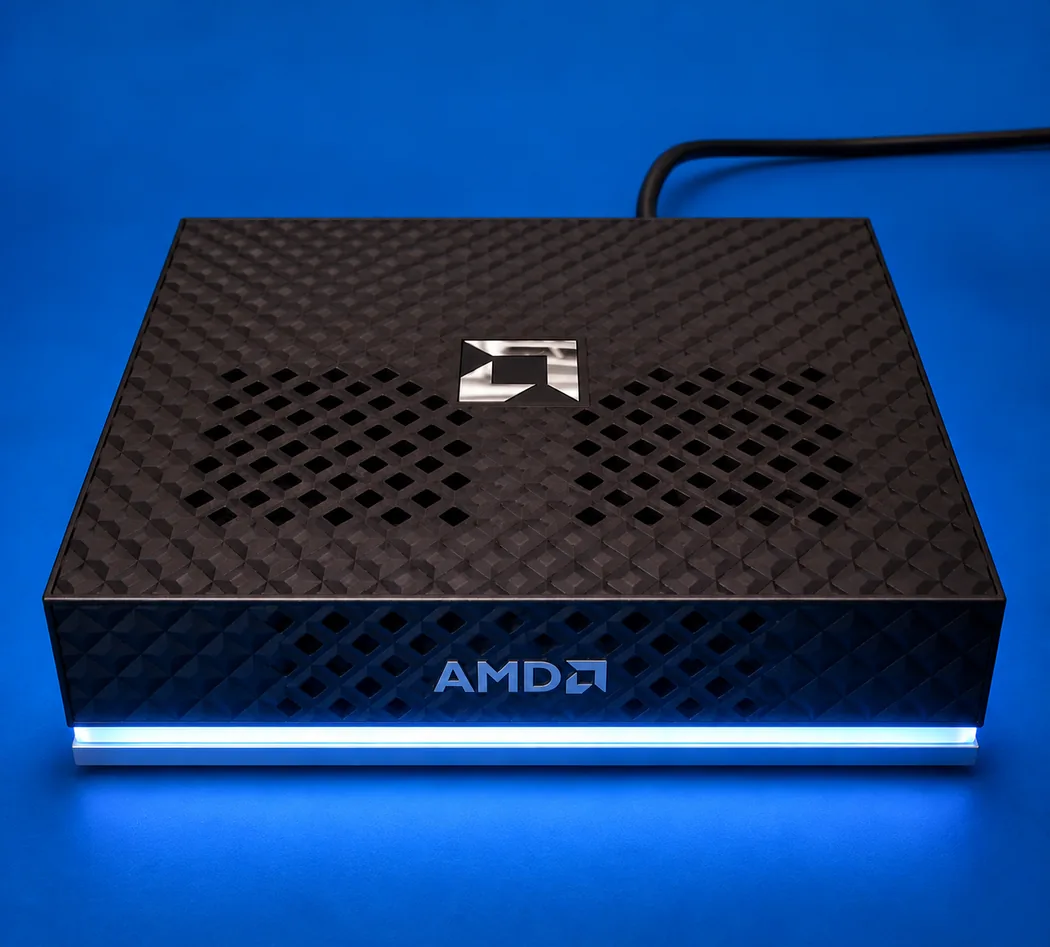
AC130 combines a 16-core AMD Ryzen AI Max+ 395 processor with Radeon 8060S integrated graphics. CPU and GPU share 128 GB of LPDDR5X memory, allowing the GPU to access models larger than the dedicated memory on a typical consumer graphics card, subject to allocation and operating-system limits.
Memory capacity is not compute performance. The integrated GPU shares memory bandwidth with the CPU and has much less GPU compute capacity than four RTX 4090 cards. Its appeal is substantial accessible memory in a compact system with comparatively modest power requirements.
B52
4× NVIDIA RTX 4090 GPUs
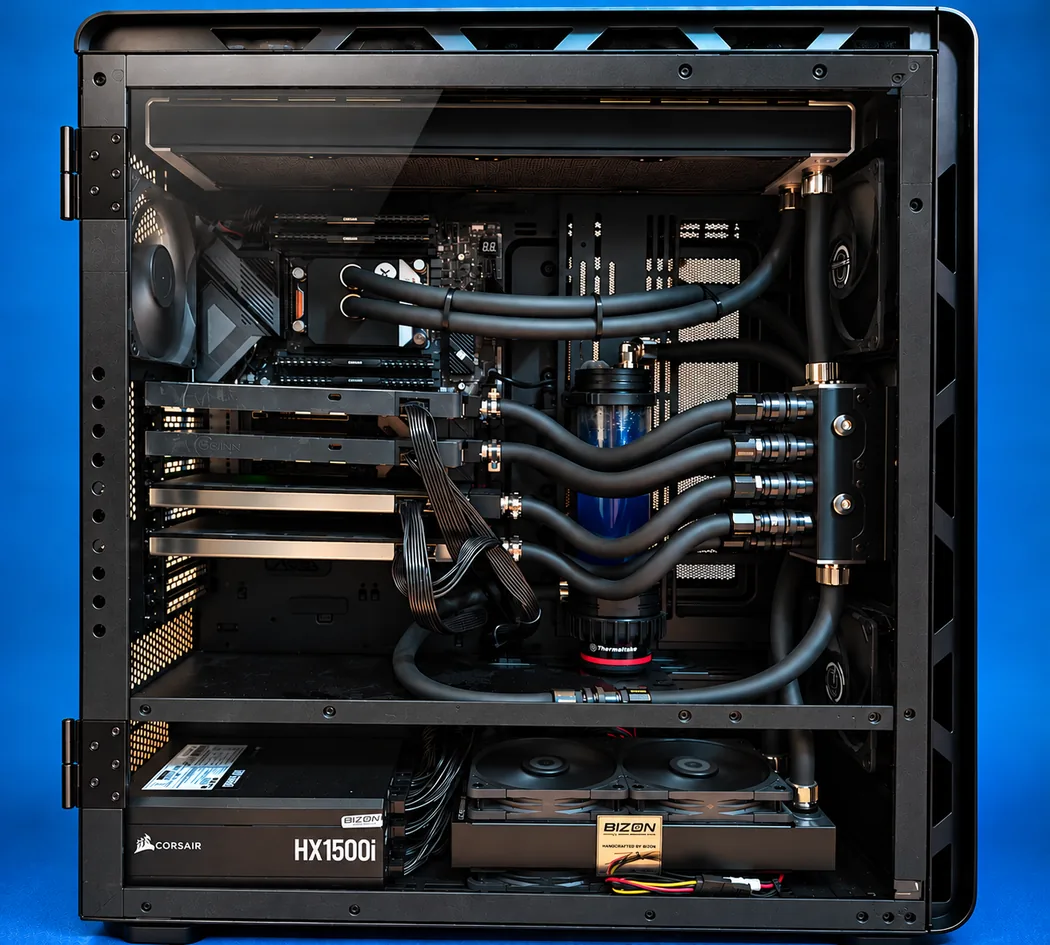
B52 combines a 24-core Threadripper PRO 5965WX, 128 GB of system RAM, and four RTX 4090 GPUs. Its 96 GB aggregate VRAM is distributed across four devices, not presented as one unified memory pool. A model that fits on one GPU can run independently; larger models can be split across cards at the cost of inter-GPU coordination.
The machine also requires more space and infrastructure: liquid cooling, two 1,500 W power supplies on separate circuits, and supplemental room air conditioning. Those costs and constraints matter alongside throughput.
How I Tested
| Model | Architecture | Quantization | File size |
|---|---|---|---|
| Qwen2.5 7B Instruct | 7.62B dense | Q4_K_M | 4.36 GiB |
| Qwen3.6 35B A3B | 34.66B MoE | Q4_K_XL | 20.05 GiB |
| Qwen2.5 72B Instruct | 72.71B dense | Q8_0 | 71.95 GiB |
I verified identical model files on both machines with SHA-256. Both used llama.cpp, but AC130 ran Vulkan build 10889 and B52 ran CUDA build 11844. The results therefore compare complete hardware-and-software configurations, not hardware in isolation.
Standard tests used 2,048 prompt tokens and 128 generated tokens, with three repetitions. Separate extended runs generated 4,096 tokens and collected power telemetry. The 35B model uses a Mixture of Experts (MoE) architecture, activating only a portion of its total parameters for each token.
Prompt Processing and Generation
Prompt processing matters when a model ingests long documents, retrieved context, or extensive conversation histories. B52 led substantially on every model.
| Model | AC130 prompt (t/s) | B52 prompt (t/s) | B52 advantage |
|---|---|---|---|
| 7B | 1,124 | 11,919 | 10.6× |
| 35B MoE | 1,070 | 8,518 | 8.0× |
| 72B | 99 | 2,680 | 26.9× |
Extended generation tells a different, though still B52-favoring, story:
| Model | AC130 generation (t/s) | B52 generation (t/s) | B52 advantage |
|---|---|---|---|
| 7B | 44.61 | 178.91 | 4.0× |
| 35B MoE | 62.84 | 223.42 | 3.6× |
| 72B | 2.81 | 12.27 | 4.4× |
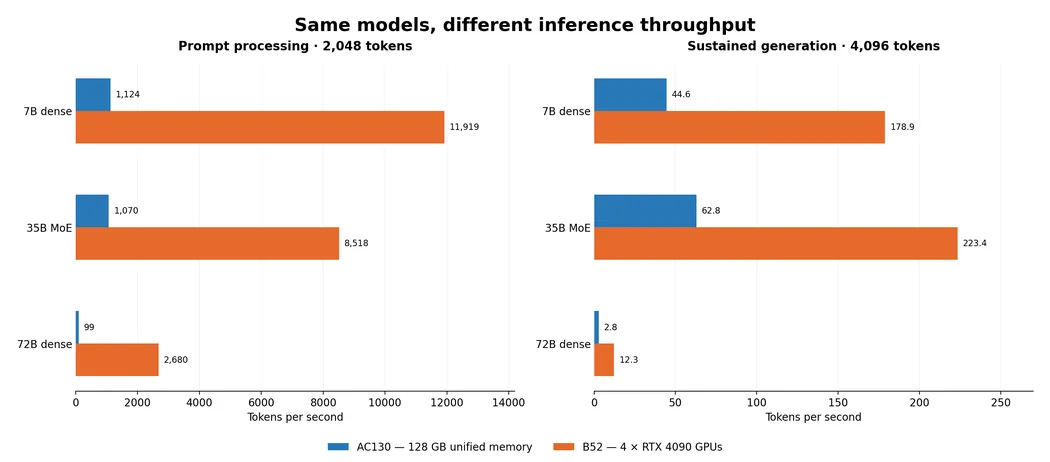
The 35B MoE model generated tokens faster than the 7B dense model on both systems. Total parameter count is not a reliable speed predictor: active parameters, model structure, memory behavior, and backend implementation all matter. This result is specific to these models and configurations.
The 72B Reality Check
Both systems ran the 72B Q8 model. AC130 accommodated it in unified memory; B52 distributed it across four GPUs. But 2.81 tokens per second on AC130 is too slow for many interactive uses, and even B52’s 12.27 tokens per second is far below its smaller-model performance. Enough memory makes a model possible, not necessarily practical.
Four Models at Once
For a concurrency test, I launched four independent 7B inference processes. On AC130 they shared the integrated GPU; on B52 each ran on a separate RTX 4090.
| Measurement | AC130 | B52 |
|---|---|---|
| Concurrent processes | 4 | 4 |
| Aggregate generation | 50.43 t/s | 716.38 t/s |
| Average per process | 12.61 t/s | 179.10 t/s |
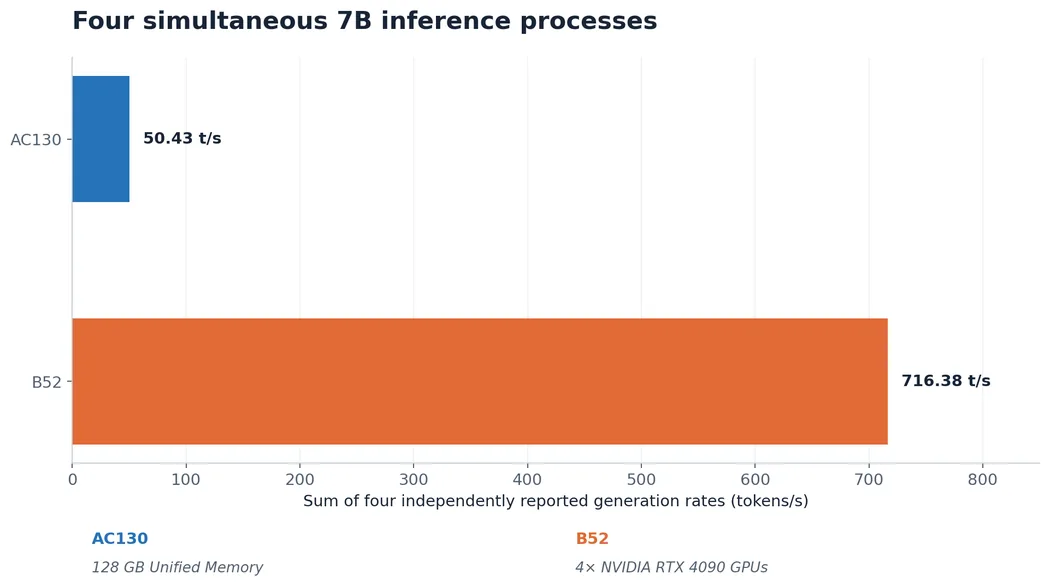
B52 delivered 14.2 times the aggregate throughput, with each GPU maintaining approximately its standalone generation rate. AC130’s per-process rate fell to roughly 12–13 tokens per second as four jobs competed for one integrated GPU. The aggregate figures are sums of independent benchmark rates, not separately measured application-serving throughput.
Power Consumption Adds Another Tradeoff
I recorded AC130’s AMD graphics-package power sensor and B52’s NVIDIA GPU telemetry, summing the active GPUs. These are not wall-power measurements, and the sensors do not necessarily cover identical electrical domains. Power averages also include some initialization and loading, so energy-per-token values below are indicative rather than calibrated generation-only measurements.
| Workload | AC130 reported power | B52 reported power |
|---|---|---|
| One 7B | 60.19 W | 349.12 W |
| One 35B MoE | 60.56 W | 254.57 W |
| One 72B | 45.18 W | 455.72 W |
| Four concurrent 7B | 56.82 W | 1,391.21 W |
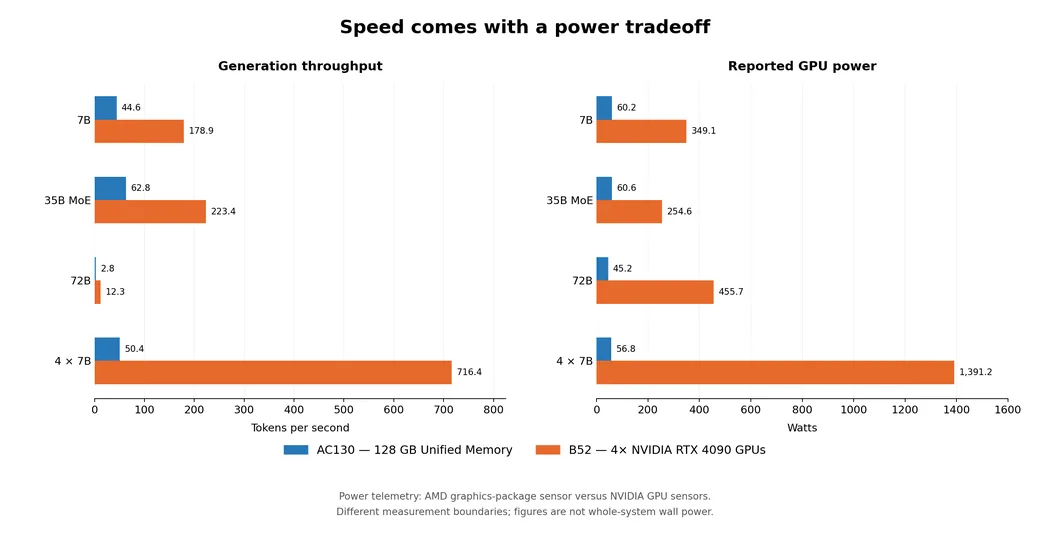
The approximate reported energy per generated token was 1.35 versus 1.95 J/token for 7B, 0.96 versus 1.14 for 35B MoE, and 16.08 versus 37.14 for 72B (AC130 versus B52). Those figures suggest a GPU-level energy advantage for AC130 in these tests, but different power boundaries and sampling periods prevent a definitive whole-system efficiency claim.
Electricity cost depends on duty cycle as much as instantaneous power. At $0.14–$0.15/kWh, a hypothetical system averaging 200 W at the wall for 30 days costs roughly $20–$22; one averaging 1,700 W costs roughly $171–$184. These are illustrations, not measured monthly costs for either computer. Cooling and idle consumption also matter.
Matching the Machine to the Mission
Benchmarks are useful, but the real question is what work needs to get done. The same advantage that matters enormously for one workload may be irrelevant for another.
| Workload | Likely better fit | Why |
|---|---|---|
| Single-user personal assistant | AC130 | Useful smaller-model speed without four discrete GPUs |
| Large-model experimentation | AC130 | Unified memory accommodates large models without multi-GPU distribution |
| Interactive inference on larger models | B52 | Faster prompt processing and generation |
| Multiple independent agents | B52 | Four GPUs isolate independent inference jobs |
| High-volume document processing | B52 | Much higher prompt-processing throughput |
| Batch generation | B52 | Faster generation and independent parallel jobs |
| Local development and prototyping | AC130 | Compact system and flexible memory capacity |
| Several separate models at once | B52 | Dedicated GPU resources when models fit individual cards |
| Continuous modest inference | AC130 | Lower reported power, pending wall-level validation |
These are not rigid assignments. AC130 is not necessarily faster at running large models; its advantage is accommodating them without multiple GPUs. B52 is not automatically the sensible choice for a single assistant whose output speed is already adequate. A short, demanding batch job may favor B52 even when its instantaneous power is much higher.
Final Thoughts
B52’s throughput advantage was substantial, especially under concurrent load. AC130’s ability to run a 72B Q8 model within unified memory was noteworthy, even at limited generation speed. Power measurements revealed another dimension, but not a universal answer.
An AC-130 and a B-52 do not perform the same mission in the same way. Their value comes from what each was designed to do. The same principle applies to local AI hardware.
The question is not which machine wins. It is which machine is suited to the mission.
Methodology note: identical SHA-256-verified GGUF files; llama-bench GPU offload enabled; standard 2,048-token prompt and 128-token generation tests repeated three times; extended 4,096-token generation runs. AC130: Vulkan build 10889. B52: CUDA build 11844. GPU telemetry is not wall power; different sensor boundaries and benchmark sampling intervals limit direct energy-efficiency conclusions.