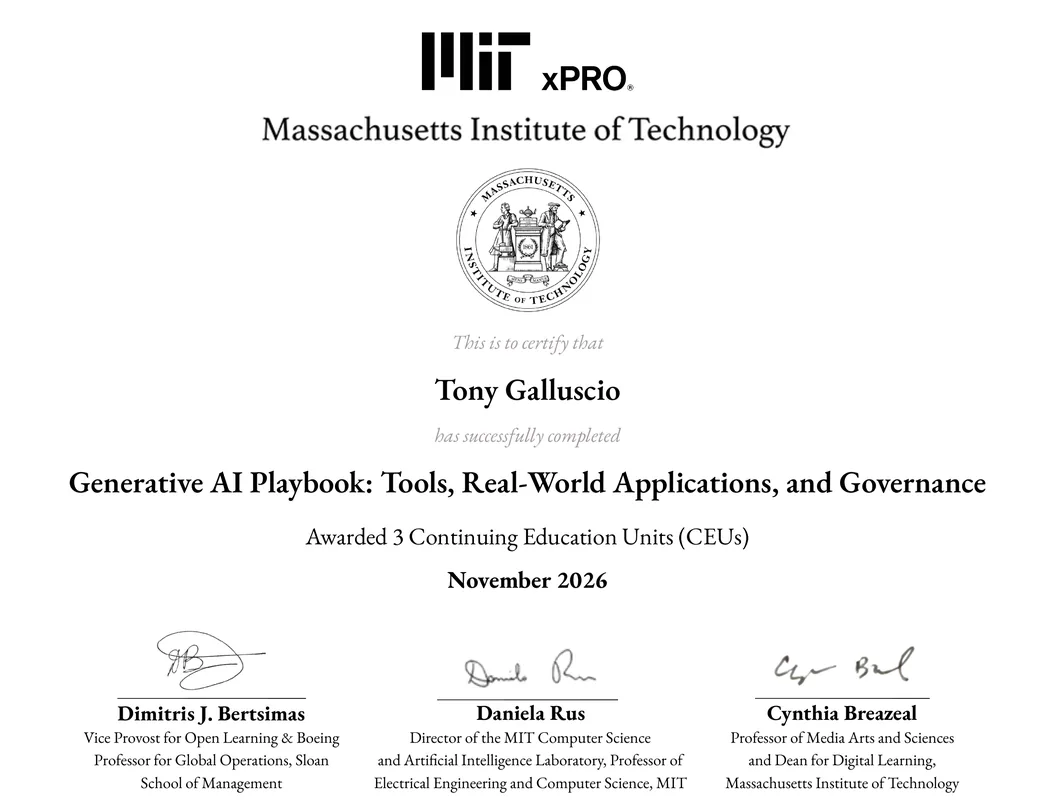
I recently completed MIT's Generative AI program. I've been working with AI for some time, but the technology is moving quickly, and I wanted to broaden my understanding, challenge some of my assumptions, and see what I might be missing.
The program began with an interesting look at how people have reacted to technological advances throughout history. Literacy, pocket calculators, and machine translation are just a few examples of innovations that were met with skepticism and sometimes outright opposition. What struck me was how similar many of those arguments were to what we're hearing about AI today. Concerns about people losing important skills, becoming too dependent on technology, or fundamentally changing how we learn and work aren't new. Yet, in each of those cases, people adapted, and the benefits ultimately outweighed the concerns. I suspect AI will follow a similar path, although there will certainly be challenges along the way.
Another takeaway was a greater appreciation for the history of AI itself. It's easy to get caught up in everything happening today and forget that much of it is built on decades of research, experimentation, successes, and failures. Generative AI didn't just appear out of nowhere. It stands on a remarkable body of work going back many decades.
The program also reinforced something I've learned through experience: the technology is only part of the solution. Getting an AI model to do something impressive isn't particularly difficult anymore. Building a system that does it reliably, consistently, and at scale is another matter entirely.
That brings me to AI's inherent limitations. These models are incredibly capable, but they're far from infallible. They can produce convincing answers that are completely wrong, behave unpredictably, and fail to recognize their own mistakes. These aren't problems we can simply ignore or assume the next generation of models will eliminate.
Good engineering still matters. Data quality, system architecture, testing, validation, performance, and cost are just as important as the models themselves. Human-in-the-loop engineering remains essential, particularly when the consequences of getting something wrong are significant.
The program also reinforced my thinking about responsible AI. Security, privacy, governance, and human oversight aren't just policy considerations. They're engineering requirements that need to be addressed when systems are designed, not after they're deployed.
For my final project, I focused on Navigator, a local AI system I've been developing. It gave me an opportunity to examine something I was already building from a different perspective and consider how some of the concepts covered in the program could improve it.
After more than 30 years in technology, I've learned that there's always something new worth understanding. Some of what I studied reinforced what I already believed. Some challenged my thinking. And I came away with a few new ideas I'm looking forward to putting to work.
It was time well spent.