When AI Changes the Economics of Modernization
Engineering judgment in the driver's seat, AI providing the acceleration.
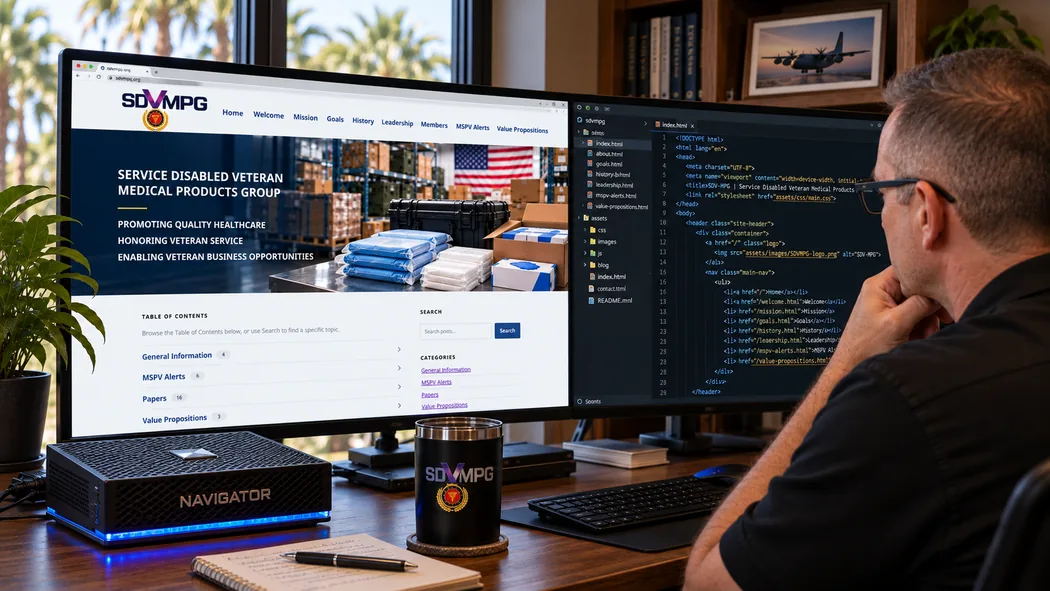
I've provided volunteer technology support to the Service Disabled Veteran Medical Products Group (SDV-MPG) since 2018, including maintaining its website and advising on technology issues when needed. Recently, as part of my volunteer technology support role, I undertook a project to modernize the organization's website and make it easier to maintain.
The existing site was embedded in a company's content management system. As I stepped away from that company, I wanted to move the site to independent, inexpensive, reliable hosting. I also wanted a faster, more modern, responsive design.
I could have built the replacement myself. I've been developing software for decades. But doing it from scratch would likely have taken weeks, and volunteer work has to fit around other commitments. With an AI development partner, I completed the modernization in an afternoon.
Starting With What Already Worked
I wasn't starting with a blank sheet of paper. I'd already simplified another website by moving away from WordPress, and I'd used AI assistance to build my consulting website. Those projects gave me a set of design patterns and a straightforward approach to static websites.
For SDV-MPG, I asked my AI partner to examine those existing projects and establish the same basic structure. Almost as quickly as I could send the instruction, I had a locally viewable, SDV-MPG-branded website ready to work on.
That was the first big acceleration. The AI didn't have to invent an architecture or work through decisions I'd already made. It could use proven patterns from previous projects and get straight to implementation.
There's another benefit to this kind of reuse. When an existing project has good practices built into it, and you explicitly tell the AI to preserve them, the next project can inherit more than its appearance. It can inherit the quality of those earlier engineering decisions.
An Afternoon of Iteration
The rest of the work was iterative. I reviewed what the AI produced, decided what needed to change, and gave it the next set of instructions. I was the judge; the AI handled execution.
Within a couple of hours, I had a site ready to show the organization's Executive Director. He liked it, and we went live.
This wasn't a throwaway prototype. It was a working production website, with historical content migrated and the features the organization needed, including navigation, search, and access to its documents.
The AI's ability to write code quickly was part of the story. Just as important was the fact that established design patterns let us skip a great deal of technical decision-making. Both contributed to the speed.
Fast Doesn't Mean Unchecked
AI-generated code can be wrong. During the migration of historical blog content, for example, an initial conversion script mishandled semicolons inside HTML while parsing SQL statements. The import failed. The problem had to be identified and the script corrected.
That's why I don't treat an AI assistant's output as finished work just because it arrives quickly. The engineer still has to know what a correct result looks like.
For this website, I use three levels of verification:
- Scripted checks before deployment. A Python QA script scans the generated pages for structural problems such as broken local links, broken fragment links, missing titles, duplicate titles, missing image descriptions, and leftover content management markup.
- Human inspection before deployment. I serve the site locally and review it myself. I decide whether the change is ready.
- AI inspection after deployment. Once the site is live, my AI partner visits the public website to check links and look for obvious problems, particularly anything that might have gone wrong during deployment.
These checks aren't an obstacle to speed. They're part of how I can move quickly without giving up control of the result.
Changing the Economics of Volunteer Work
For a volunteer, time matters. You want to contribute meaningful work without allowing it to consume the time needed for your other responsibilities. But the organization still deserves professional-quality results.
AI-assisted development changes that equation. I can tell my on-premises AI agent what needs to change, review the result locally, and deploy it. Publishing a blog article is similarly straightforward: add the media, fill out a .post template, build the site, review it, and deploy. In most cases, routine updates take single-digit minutes.
At a recent SDV-MPG meeting, I was comfortable promising same-day turnaround on website updates, additions, and changes. I wouldn't make that commitment lightly. The new approach makes it practical.
That may be the most meaningful result of the modernization. It wasn't just that the initial project took an afternoon. The organization now has a site that can be maintained quickly and consistently over time.
Where to Draw the Line
I think experienced developers can adopt AI-assisted engineering quite naturally. The risk is giving the AI too much control, especially when you don't yet have the experience to recognize a poor technical decision.
There is a balance to strike. Delegate execution while retaining responsibility for architecture, requirements, quality, and acceptance. Draw that line in the right place and you get a substantial speedup. Draw it poorly and you can end up with rework, slower progress, and lower quality.
The SDV-MPG project reinforced something I've come to believe about AI-assisted software development: AI doesn't replace engineering experience. It amplifies the value of that experience.
I didn't need AI to know how to build this website. I needed it to make the work practical within the time I could give. That's a meaningful change in what an experienced engineer can accomplish, particularly for smaller organizations and projects where the traditional cost of development is hard to justify.
Visit the completed website at sdvmpg.org.